
If you wear glasses and work on site, you have probably been handed a pair of over-specs at some point. The big clear goggles that go over your own glasses. They work, in that they stop things hitting your eye. But anyone who has worn them for a full day will tell you they are not a long term answer.
The alternative is prescription safety glasses, where your prescription is built into a certified safety frame. This article covers both options, what you need to order a prescription pair, and what your employer is required to do under UK PPE law.
What is wrong with over-specs?
Nothing, on paper. Over-specs are tested to EN166 and do stop impact. The problems are practical.
They fog. You have two pairs of lenses with a pocket of warm air trapped between them. Your own glasses fog, the over-specs fog, often both at once. An anti-fog coating on the outer pair does nothing for the inner pair. A single prescription lens fixes that at source, and on Salus prescription lenses anti-fog is available as an optional add-on, with anti-scratch as standard.
They are uncomfortable. Over-specs have to fit over a wide range of frames, so they are bulky. The arms sit on top of your own arms and double the pressure behind your ears. Add ear defenders and a hard hat and by mid-morning you have a headache.
They reduce vision. Two layers of plastic means more reflections, scratches and smears, and the thick frame cuts your peripheral vision.
They come off. This is the real issue. People push them up, take them off for a quick cut, or leave them in the van. Eye protection you are not wearing has a protection rating of zero.
What are prescription safety glasses?
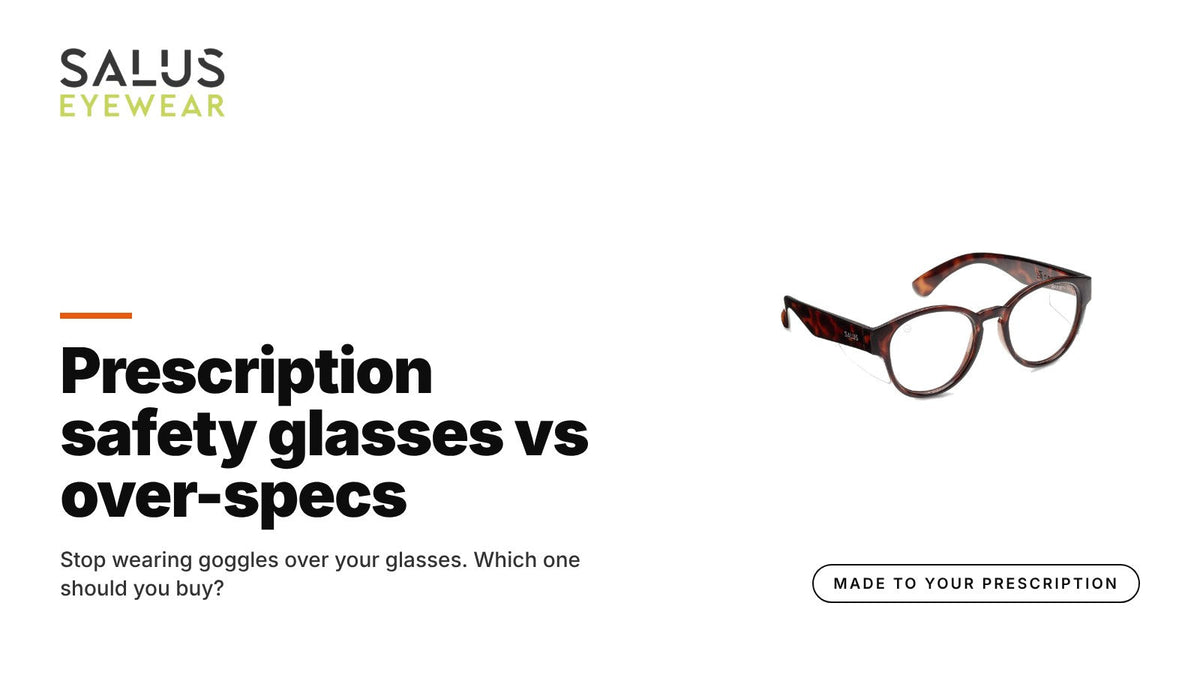
Prescription safety glasses are a certified safety frame fitted with lenses made to your prescription. They look and feel like a normal pair of glasses, but the frame and lenses are built and tested to EN166.
You get one pair of lenses, so an anti-fog coating actually works. The frame fits like regular glasses, so nothing doubles up on your ears or nose. You can get them clear or tinted, with the same impact rating as the non-prescription clear lens safety glasses in the same frame.
The whole unit is the safety product. Putting prescription lenses into an ordinary fashion frame does not make safety glasses, even if the lenses are polycarbonate. The frame has to hold the lens under impact, and that is part of what EN166 tests.
Salus Eyewear offers the Nova and Flux frames with prescription lenses in our prescription safety glasses collection. Both frames are rated EN166 F T K N with built-in side protection, and every Salus lens is UV400 rated, including the clear prescription ones.
What do you need to order prescription safety glasses?
Two things.
Your current prescription. Your optician has to give you a copy after an eye test, whether or not you buy glasses from them. It should be less than two years old. It lists sphere (SPH), cylinder (CYL) and axis for each eye, and may include an ADD value for reading correction.
Your pupillary distance (PD). The distance between the centres of your pupils in millimetres, needed to line up the optical centre of each lens with your eye. Some opticians put it on the prescription and some do not. If it is missing, ask for it, or measure it with a ruler and a mirror. Most adults are between 54 and 74mm.
If you need varifocals or bifocals, say so when you order, because not every safety frame can take them. Have both your prescription and your PD to hand when you order a Salus pair.
Who should consider prescription safety glasses?
Anyone who wears glasses and needs eye protection for more than the odd ten minutes. In practice:
- Tradespeople making do with over-specs or, worse, just their normal glasses.
- People who keep taking over-specs off because of fogging or discomfort.
- Anyone who wants one pair that works in the van and on site.
- Employers who want eye protection that actually gets worn.
Over-specs still have a place for visitors, short tasks, or as a backup. For everyday wear by someone who needs vision correction, prescription safety glasses are the right tool. That one pair for van and site is exactly what the Salus Nova and Flux prescription frames are designed to be.
Does my employer have to pay for prescription safety glasses?
The Personal Protective Equipment at Work Regulations 1992 require employers to provide suitable PPE to anyone exposed to a risk at work that cannot be adequately controlled by other means. The regulations were amended in 2022, and from 6 April 2022 the duties also cover limb (b) workers, meaning casual and agency type workers on a contract for services as well as direct employees. Self employed people are not covered.
The employer must assess the risk, choose PPE that is suitable for the job and the person, provide it, maintain and replace it, train people in its use, and do all of this free of charge. The HSE is direct: you cannot charge workers for PPE they need to do their job.
The word that matters for glasses wearers is suitable. If over-specs stop a worker seeing clearly or cause them to take their eye protection off, there is a good case that prescription safety glasses are the suitable option and the employer should provide them.
This does not mean an employer has to pay for your everyday glasses or a general eye test. It means the eye protection provided has to work for you. If you are self employed, the cost is yours, but it is a business expense like your boots and hard hat. Salus supplies employers through trade accounts as well as selling direct, so a firm kitting out a few glasses wearers can do it in one order.
Which should you buy?
If you need glasses and wear eye protection regularly, buy prescription safety glasses. They cost more than over-specs, but you will wear them, which is the only thing that matters. Keep a pair of over-specs in the van for anyone who turns up without eye protection.
If you only need eye protection occasionally, over-specs are fine, as long as you keep them on. Salus prescription glasses use the same Nova and Flux frames as the standard range, so they look like the glasses the rest of the team are wearing.
FAQ
Can I get prescription safety glasses with tinted lenses?
Yes. Prescription lenses can be clear or tinted. Tinted is useful for outdoor work and driving. Make sure the tinted version still carries the EN166 impact marking. Salus prescription lenses come clear or tinted, and every Salus lens is UV400 rated whichever you choose.
How old can my prescription be?
Most suppliers accept a prescription up to two years old. If yours is older, book an eye test first. A wrong prescription in safety glasses is uncomfortable and potentially unsafe.
Do prescription safety glasses meet the same standard as normal safety glasses?
They should, and you should check. Look for the EN166 marking and the F impact rating on frame and lens. If a supplier cannot tell you the rating, go elsewhere. Salus prescription frames carry the same F T K N marking as the standard range.
Sources: HSE, Extended scope of the Personal Protective Equipment at Work Regulations (hse.gov.uk/ppe/ppe-regulations-2022.htm); PPE at Work Regulations 1992 as amended by the PPE at Work (Amendment) Regulations 2022.
Share:
EN166 F, FT, K and N explained in plain English