
Pick up a pair of safety glasses and look at the arm. You will see a string like EN166 1 FT KN or 2C-1.2 1 F. Most people never read it. But that marking is the only proof the glasses will do what they are supposed to, and once you know the code it takes five seconds to check.
This is a plain English guide to EN166 markings, written for people who wear the glasses rather than people who write standards.
What is EN166?
EN166 is the European standard for personal eye protection. It sets out what spectacles, goggles and face shields have to do, and defines the marking that tells you how a product performed in testing. In the UK it is published as BS EN 166, and the Health and Safety Executive points employers to it when choosing eye protection.
The standard tests the lens and the frame separately, and both carry their own marking. On most spectacles the lens marking is etched into the lens and the frame marking is on the arm. Salus Nova and Flux frames are certified to EN166 and carry the marking on both lens and arm.
What do F, B and A mean?
These letters are the impact rating. They tell you how fast a steel ball can hit the glasses without the lens breaking or coming out of the frame.
- S is increased robustness. The minimum level, a slow drop test at around 5.1 metres per second. Fine for a visitor's pair, not for a trade.
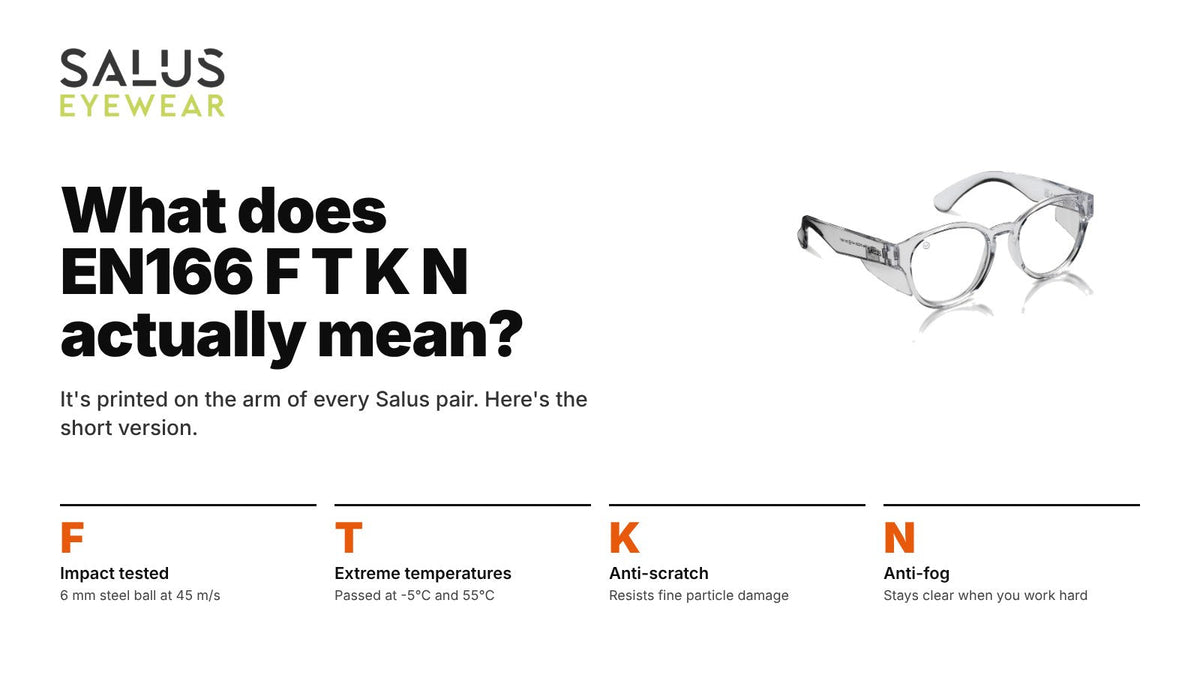
- F is the spectacles grade: the lens and frame are tested with a 6 mm steel ball fired at 45 m/s, about 100 mph. It is the highest grade an open spectacle frame can carry, so every certified pair of safety glasses on the market is F. It covers trade work: chips, dust, fixings and debris from hand and power tools.
- B is the goggles grade, tested at 120 m/s.
- A is the face shield grade, 190 m/s.
The impact letter appears on both the lens and the frame. F is the highest grade an open spectacle frame can carry under the standard, so if someone offers you spectacles marked B, be suspicious. Both Salus frames carry the F marking on lens and frame, with built-in side protection so the lens covers the side of the eye as well as the front.
What does the T after F mean?
Plastic goes brittle in the cold and softens in the heat. The T suffix means the impact test was carried out at extreme temperatures, minus 5 to plus 55 degrees Celsius, and the glasses still passed.
You will see it written as FT, F(T) or F-T. It only ever appears alongside an impact letter. On its own T means nothing.
For UK trades this matters. A frosty morning on a roof is below 5 degrees. A loft in July or a van parked in the sun gets well past 40. Glasses without the T were only tested at room temperature. Glasses with it were tested across the range you actually work in. All Salus frames are rated F T, so they have been tested across that range.
What do K and N mean?
These relate to lens coatings and are optional extras.
K means the lens passed the test for resistance to surface damage by fine particles. In normal language, scratch resistant. Dust from plaster, cement or MDF acts like sandpaper on a bare polycarbonate lens, so K-rated lenses stay clear for longer.
N means the lens passed the anti-fog test. This is the marking to look for if your glasses keep misting up during physical work.
A lens marked 1 FT KN has passed the F impact test at extreme temperatures, with scratch resistance and anti-fog. That is the combination you want for everyday trade use, and it is what Salus Eyewear's Nova and Flux frames carry. All Salus lenses are anti-scratch and anti-fog as standard (anti-fog is an optional add-on on prescription lenses).
What does the 1, 2 or 3 mean?
This is the optical class, and it tells you how clear and distortion free the lens is.
- Class 1 is the highest optical quality. It is intended for continuous wear and is what you want if the glasses are going on at 7.30 and coming off at 5.
- Class 2 is for intermittent use. Slightly more distortion is allowed.
- Class 3 is for occasional, short term use only. You would not want to wear these all day.
Optical class only appears on the lens marking. For spectacles you plan to wear all day, look for Class 1. Salus Nova and Flux lenses are Class 1.
What about the other numbers at the start?
If the lens is tinted or filters UV, the marking begins with a scale number. The most common ones on safety glasses are:
- 2C-1.2 or 2-1.2 for a clear UV filter lens. The 2C means UV filter with good colour recognition. The 1.2 is the shade number, where 1.2 is essentially clear.
- 5-2.5 or 5-3.1 for a sunglare filter, which is what you see on smoked or tinted lenses.
Every Salus lens is UV400 rated, including the clear ones, so the clear, UV400 smoked, polarised and prescription lenses all block UVA and UVB up to 400 nanometres.
Goggles and shields may also carry field of use numbers: 3 for liquid splash, 4 for large dust, 5 for gas and fine dust, 8 for electric arc, 9 for molten metal. These do not apply to open spectacles.
UKCA or CE: which one do you need in the UK?
Every EN166 product also carries the manufacturer's mark and either the CE mark, the UKCA mark, or both. If you cannot find a manufacturer's mark, treat the glasses as uncertified whatever the packaging says.
After Brexit the UK introduced UKCA to replace CE for products sold in Great Britain, with a plan to stop recognising CE after a deadline. In August 2023 the government announced CE marking would continue to be recognised indefinitely for most product categories, and later confirmed this includes PPE. So in Great Britain either mark is acceptable, provided the certification behind it is real. Northern Ireland follows EU rules, so CE is required there.
The honest summary: either mark is fine for a UK site. What matters more is that the EN166 marking and the impact rating are present. On a Salus frame you will find the EN166 F T K N marking on the arm, which is the bit to check.
FAQ
Is EN166 F enough for construction work?
Yes. F is the highest impact grade an open spectacle frame can carry, so every certified pair of safety glasses on the market is F. If you work outdoors in winter or in hot roof spaces, look for the T suffix as well.
What is the difference between EN166 F and FT?
Both passed the 45 metres per second impact test. FT also passed it at minus 5 and plus 55 degrees Celsius. FT is the better choice for outdoor work. All Salus frames are FT.
Do I need UKCA marked safety glasses in the UK?
No. CE marking continues to be recognised in Great Britain, including for PPE. UKCA is also accepted. Either is fine as long as the product is certified to EN166.
Sources: BS EN 166:2002 marking guidance published by JSP Safety and Globus Group; HSE guidance on personal protective equipment at work; Department for Business and Trade announcements on continued CE marking recognition.
Share:
Do you need polarised safety glasses on site?