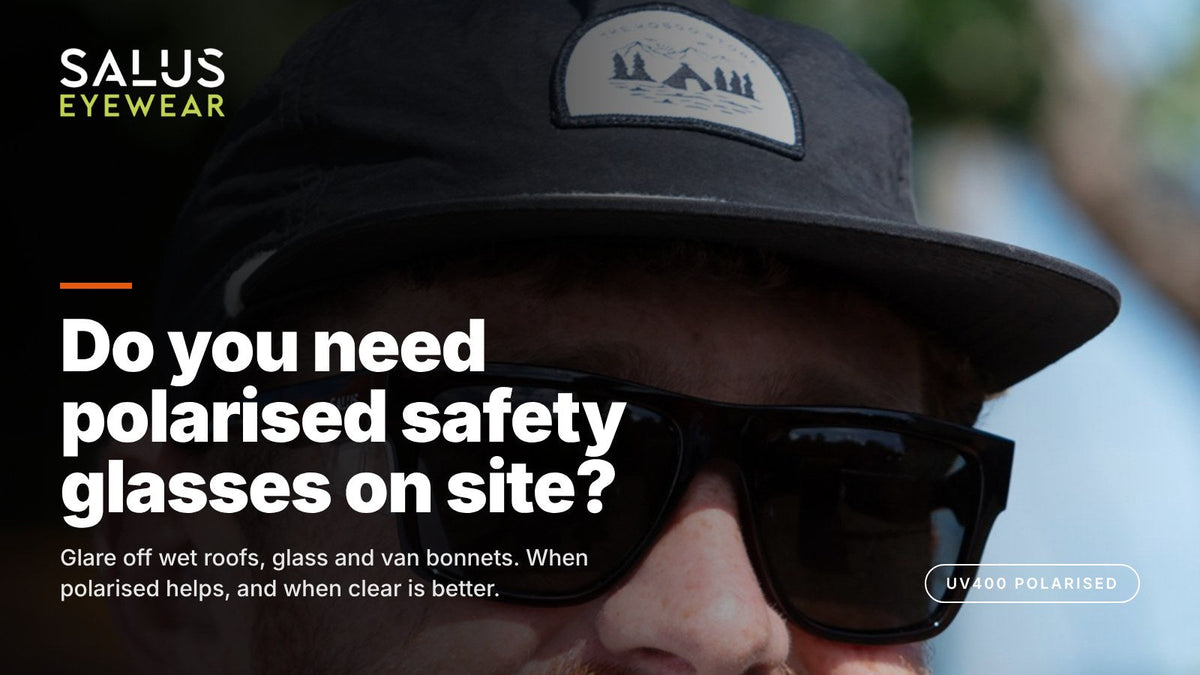

Polarised lenses get sold as the premium option, and on a boat or a ski slope they earn that. On a building site it is less clear cut. Some days they are the best thing you can put on your face. Other days a plain clear or smoked lens does the job better. Here is how to decide.
What do polarised lenses actually do?
Light bouncing off a flat surface comes back mostly in one plane. That is glare. Polarised lenses have a filter that blocks light in that plane, so the harsh reflections drop away while everything else comes through.
The practical version of that is this. Standing in a yard after rain, the puddles stop looking like mirrors. The white glare off a wet road softens. The flash off a van bonnet or a glazed window stops blinding you. Wet scaffold boards, which can throw back a sheet of light on a bright morning, look like scaffold boards again.
Ordinary smoked lenses darken everything equally. Polarised lenses cut the glare specifically. That is the difference, and it is why polarised feels so much more comfortable in certain conditions. Salus offers polarised lenses in both the Nova and Flux frames, alongside the clear and smoked versions.
When do polarised safety glasses help on site?
Roofing. Up on a roof you have nothing between you and the sky, and if the roof is wet, slate, lead or a membrane, the reflection comes at you from below too. Polarised lenses take the sting out of that and make it easier to spot a lap or a fixing line.
Groundworks and external works. Standing water in a trench, wet concrete, a muddy site in winter sun. All flat, all reflective. Polarised lenses help you see what is under the water rather than the sky reflected on it.
Driving between jobs. Most tradespeople spend a chunk of the day in the van. Low winter sun on a wet road is one of the worst glare situations there is. A pair of polarised safety glasses that you can wear from the site to the next job without swapping is genuinely useful, and the Salus frames are designed to look like normal glasses so you will actually keep them on for the drive.
Coastal work. If you work near the sea, as a lot of us do in Jersey, the glare off water and wet sand is constant. Polarised was designed for exactly this.
When are clear or plain UV400 lenses better?
Polarised is not always the right call, and anyone telling you otherwise is selling something.
Reading LCD screens. Many LCD displays emit polarised light. Depending on the angle, a polarised lens can make the screen look dark, patchy or blank. This applies to some laser level receivers, moisture meters, digital gauges, phones and the touchscreen in a lot of vans. If your work involves constantly reading an instrument, try polarised glasses with that specific device before you commit to them.
Low light and indoors. Polarised lenses are tinted, so they cut light levels. Inside a half-built house with the windows boarded, or in a loft, you want a clear lens. Swapping between tinted and clear as you go in and out is a pain, so a lot of people keep clear glasses on indoors and a tinted pair for outside.
Reading ice and wet patches. A less obvious one. Polarised lenses can make a sheen of ice or water on a surface harder to see, because they remove the reflection that would normally warn you. If you are working on a frosty roof or a wet slab in winter, bear that in mind.
If you mostly need protection from UV and brightness rather than reflected glare, a plain UV400 smoked lens does the job. UV400 means the lens blocks UVA and UVB up to 400 nanometres. Polarised lenses in a decent safety frame will also be UV400, but UV400 on its own does not mean polarised. They are two different properties. Every Salus lens is UV400 rated, including the clear ones, so whichever you pick you are covered for UV.
Are polarised sunglasses the same as safety glasses?
No, and this is the bit that matters most. Polarised is a lens property. It tells you about glare. It tells you nothing about whether the lens will stop a chip of brick or a bent nail.
Ordinary polarised sunglasses from a petrol station or a fashion brand are not impact tested. Hit one with a flying offcut and the lens can crack or come out of the frame. For site use you need the lens and the frame to be certified to EN166, with an impact rating on the marking. For spectacles that is F. F is the spectacles grade: the lens and frame are tested with a 6 mm steel ball fired at 45 m/s, about 100 mph.
So do not stop at the word polarised. Look for EN166 and the F marking, and ideally the UKCA or CE mark alongside it. If those are not there, it is a pair of sunglasses, not PPE.
Salus Eyewear polarised lenses are built into the same EN166 certified Nova and Flux frames as the clear and smoked versions, so the impact protection is the same across the range. All Salus frames are rated F T K N, with built-in side protection, and all Salus lenses are anti-scratch and anti-fog as standard. You can see the options in our polarised lens safety glasses collection. If you want something for indoor work to go alongside them, the clear lens safety glasses use the same frames.
So should you buy polarised?
If you spend most of your day outside, drive a lot, work on roofs, near water or on wet ground, yes. The difference in eye strain over a full day is real.
If you work mostly indoors, in poor light, or spend your day reading digital instruments, buy clear lenses first and treat polarised as a second pair for the right conditions. Salus clear and polarised lenses come in the same frames, so a second pair fits exactly the same way as the first.
Either way, make sure the pair you buy is marked EN166 F. Glare protection is a bonus. Impact protection is the point.
FAQ
Can I drive in polarised safety glasses?
Yes, and many people find them better than ordinary sunglasses for driving because they cut road glare. Check that your van's dashboard screen or sat nav is still readable, as some LCD screens go dark through polarised lenses at certain angles.
Do polarised lenses protect against UV?
Not automatically. Polarising and UV filtering are separate properties. Look for UV400 on the specification as well as polarised. Any proper safety lens will state both. Every Salus lens, polarised included, is UV400 rated.
Are polarised safety glasses allowed on site?
If they are certified to EN166 with an impact rating, they are safety glasses and are fine on site. If they are only polarised sunglasses with no EN166 marking, they are not PPE and most sites will not accept them.
Share:
Best safety glasses for carpenters and joiners: what actually matters on site