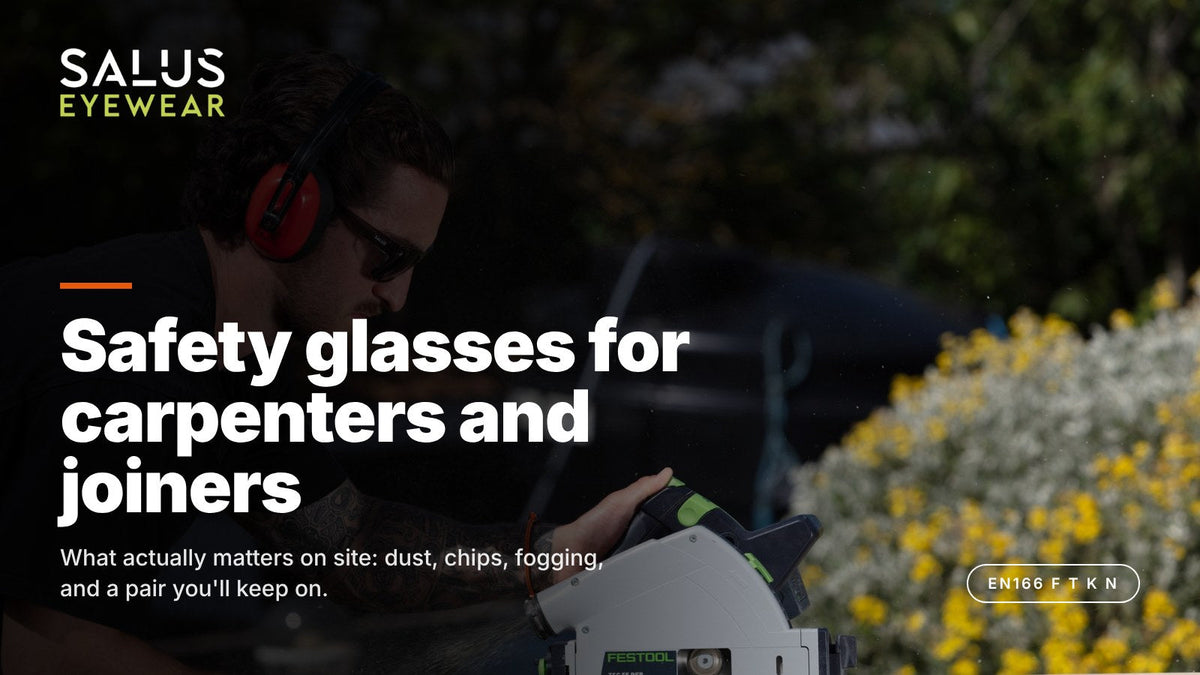

Ask ten carpenters where their safety glasses are and half of them will point at the van. The other half will have them pushed up on their head, misted over, with a layer of MDF dust on the inside. That is the real problem with eye protection in our trade. It is not that nobody owns a pair. It is that the pair they own is horrible to wear, so it does not get worn.
This guide is about what actually matters when you are choosing safety glasses for carpentry and joinery work, whether that is first fix on a wet site in February or second fix and kitchen fitting indoors.
What are the main eye hazards for carpenters?
Most eye injuries in woodwork are not dramatic. They are a chip of oak off a chop saw, a splinter flicked up by a planer, or a cloud of fine dust from cutting MDF or plasterboard. Nail guns and fixings add another layer, because a bent brad or a ricochet off a steel hanger moves fast and comes from an angle you were not watching.
Then there is the stuff that is not about impact. Sawdust in the eye is an irritation, but rubbing your eyes with hands covered in PU adhesive or wood preservative is a bigger problem. A decent pair of glasses stops you doing that without thinking. Both Salus frames, the Nova and the Flux, are rated EN166 F T K N, so they are tested against exactly this kind of flying debris.
Why do safety glasses fog up and what can you do about it?
Fogging is the number one reason glasses come off on site. You are humping 18mm ply up a ladder, your face is warm, the air is cold and damp, and within thirty seconds you cannot see your pencil line.
Two things help. The first is a proper anti-fog coating on the lens, not a wipe-on spray that lasts an hour. Under EN166, a lens that passes the anti-fog test is marked with the letter N. The second is frame design. Glasses that sit right against your face trap warm air and fog faster. A frame that leaves a bit of airflow around the lens edge, without opening up a gap for debris, strikes the right balance. All Salus lenses are anti-fog and anti-scratch as standard (anti-fog is an optional add-on on prescription lenses), and both frames are shaped for that airflow.
Do carpenters need side protection?
Yes. Most of what hits you does not come straight on. A chop saw throws offcuts sideways. A router spits chippings in a spiral. If you are nailing skirting at floor level, the brad that bends can come up and out at any angle.
Normal glasses or sunglasses have an open gap at the temples, which is exactly where a flying chip gets in. Proper safety glasses have a wraparound lens or built-in side shields that close that gap. EN166 impact testing fires the ball at the side of the eye area too, not just the front. Both Salus frames have built-in side protection, with the lens wrapping round to close the temple gap.
Clear lenses or UV400 smoked for outdoor work?
This depends on where you spend your day.
- Clear lenses are the default for indoor second fix, joinery shops, and anything in a dim room or under artificial light. You want to see true colour on a timber match or a grain line, and clear lenses give you that.
- UV400 smoked lenses make sense for roof carpentry, timber frame erection, decking and fencing, or any job where you are outside all day. They cut glare off a bright sky and off wet timber, and UV400 means they block UVA and UVB up to 400 nanometres.
Plenty of lads keep one of each in the van. If you do mixed work, that is the right answer. Every Salus lens is UV400 rated, including the clear ones, so your indoor pair still blocks UV when you step outside to cut.
You can see both options in our clear lens safety glasses range and the wider carpenters safety glasses collection.
Why do safety glasses end up in the van?
Be honest about this one. Glasses come off for three reasons.
Comfort. Cheap frames pinch behind the ears and dig into your nose. After an hour you get a headache, so you take them off. Weight and arm shape matter, especially under ear defenders or a hard hat that presses the arms into your head. Salus frames are built light with slim arms for exactly that reason.
Fogging. Covered above. If you cannot see, they are coming off.
Looks. Nobody likes to admit it, but if your glasses look like they came free with a tin of paint, you will not wear them to the merchants, driving between jobs, or when the client is around. Glasses that look like a normal pair of specs stay on your face all day, which is the whole point.
That last point is why Salus Eyewear made the Nova and Flux frames look like something you would choose to wear rather than something handed to you at an induction. If they stay on, they work.
What does EN166 F mean on safety glasses?
EN166 is the European standard for eye protection, and the one most UK site PPE policies refer to. The letter after it is the impact rating.
F is the spectacles grade: the lens and frame are tested with a 6 mm steel ball fired at 45 m/s, about 100 mph. It is the highest grade an open spectacle frame can carry, so every certified pair of safety glasses on the market is F.
For carpentry and joinery, F covers the kind of chips, dust and fixings you deal with. If you also see a T after the F, that means the impact test was passed at extreme temperatures from minus 5 to plus 55 degrees Celsius, which is relevant if you work outside in winter or in a hot roof space.
The other letters you might see are K for scratch resistance and N for anti-fog. Glasses marked F T K N tick all four boxes, and all Salus frames carry that F T K N marking. Look for both UKCA and CE marks if you want to be sure they are certified for sale in the UK and the EU.
FAQ
Can I wear normal sunglasses for carpentry work?
No. Fashion sunglasses are not impact tested, they have gaps at the sides, and the lenses can shatter into your eye if hit. You need glasses marked EN166 with an F impact rating.
Are anti-fog safety glasses worth it for indoor joinery?
Usually yes. Even indoors, physical work raises your face temperature and a workshop in winter is cold. An N-rated lens makes the difference between glasses you wear and glasses you keep taking off. Salus lenses carry the N rating as standard.
Do I need UV400 lenses if I mostly work inside?
Not for indoor work. Clear lenses give you better colour and light. Keep a smoked pair for roof work or outdoor framing, or if you spend a lot of time driving between jobs. With Salus you get UV400 either way, as every lens in the range is UV400 rated, clear included.
Share:
Salus Eyewear Launches Prescription Safety Glasses That Combine Style and Certified Protection